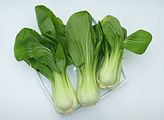
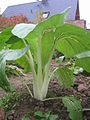
Bok choy (American English), pak choi (British English), pichay/petsay (Philippine English), or pok choi (Brassica rapa subsp. chinensis) is a type of Chinese cabbage. Chinensis varieties do not form heads and have green leaf blades with lighter bulbous bottoms instead, forming a cluster reminiscent of mustard greens. Chinensis varieties are popular in southern China, East Asia, and Southeast Asia. Being winter-hardy, they are increasingly grown in Northern Europe. Now considered a subspecies of Brassica rapa, this group was originally classified as its own species under the name Brassica chinensis by Carl Linnaeus.[citation needed] They are a member of the family of Brassicaceae or Cruciferae, also commonly known as the mustards, the crucifers, or the cabbage family.

Spelling and naming variations
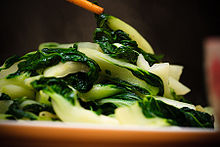
Other than the ambiguous term "Chinese cabbage", the most widely used name in North America for the chinensis variety is simply bok choy (Cantonese for "white vegetable") or siu bok choy (Cantonese, for "small white vegetable"; as opposed to dai bok choy meaning "big white vegetable" which refers to the larger Napa cabbage). It can also be spelled pak choi, bok choi, and pak choy. In the UK and South Africa, the term pak choi is used. Less commonly, the descriptive English names Chinese chard, Chinese mustard, celery mustard, and spoon cabbage are also employed.
In Australia, the New South Wales Department of Primary Industries has redefined many transcribed names to refer to specific cultivars. In addition, they have introduced the word buk choy to refer to a specific kind of cabbage distinct from pak choy.[2][3]
In Mandarin Chinese, a common name is 青菜 qīng cài (literally "green vegetable").[citation needed]Although the term 白菜 is pronounced "baak choi" in Cantonese, the same characters are pronounced "bái cài" by Mandarin speakers and used as the name for Napa cabbage which they call "Chinese cabbage" when speaking English.[citation needed]
In the Philippines, it is called pichay or petsay in Tagalog.[4][5]
What is labelled Bok Choy may come in 2 forms: traditional true bok choy (Chinese: 小白菜; lit. 'small white vegetable') or Shanghai bok choy (Chinese: 上海青; lit. 'Shanghai green'). Regular bok choy is usually more expensive and has a dark crinkly colored leaves and stem portions that are white and crisp texture that is more suitable to Cantonese style cooking, stir fries, and simple or raw preparations.[6] Shanghai bok choy has greater availability in most American Markets and has mild tasting spoon shaped leaves that are lighter green with stems that are jade green instead of white. The texture of Shanghai bok choy is less crisp and gets slimy if overcooked but otherwise can be substituted in many cooking applications when true bok choy is unavailable.[7]
Nutritional value
Raw bok choy is 95% water, 2% carbohydrates, 1% protein and less than 1% fat (table). In a 100-gram (31⁄2-ounce) reference serving, raw bok choy provides 54 kilojoules (13 kilocalories) of food energy and is a rich source (20% or more of the Daily Value, DV) of vitamin A (30% DV), vitamin C (54% DV) and vitamin K (44% DV), while providing folate, vitamin B6 and calcium in moderate amounts (10–17% DV) (see table).
Toxic effects
Bok choy contains glucosinolates. These compounds have been reported to prevent cancer[citation needed] in small doses, but, like many substances, can be toxic to humans in large doses, particularly to people who are already seriously ill. In 2009, an elderly diabetic woman who had been consuming 1 to 1.5 kilograms (2 lb 3 oz to 3 lb 5 oz) of raw bok choy per day in an attempt to treat her diabetes developed hypothyroidism for reasons relating to her diabetes,[citation needed] resulting in myxedema coma.[8] According to the case study published by her treating physicians, raw bok choy releases an enzyme which can inhibit the uptake of iodine, when eaten in large amounts over extended periods.[9]
History
Bok choy evolved in China, where it has been cultivated since the 5th century AD.[1]
Gallery

| This article uses material from the Wikipedia article Metasyntactic variable, which is released under the Creative Commons Attribution-ShareAlike 3.0 Unported License. |