The ghost pepper,[2][3] also known as bhut jolokia (which literally means Bhutanese chilli in Assamese[4]), is an interspecific hybrid chili pepper cultivated in Northeast India.[5][6] It is a hybrid of Capsicum chinense and Capsicum frutescens and is closely related to the Naga Morich.[7]
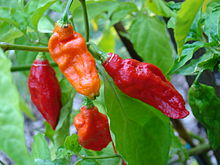

In 2007, Guinness World Records certified that the ghost pepper was the world's hottest chili pepper, 400 times hotter than Tabasco sauce.[neutrality is disputed] The ghost chili is rated at more than one million Scoville Heat Units (SHUs). However, in the race to grow the hottest pepper, the ghost chili was superseded by the Trinidad Scorpion Butch T pepper in 2011 and Carolina Reaper in 2013.[8]
Etymology and regional names
The name bhüt jolokia (ভোট জলকীয়া) means Bhutanese pepper in Assamese; the first element bhüt, meaning Bhutanese, was mistakenly confused for a near-homonym bhut meaning ghost, thus producing the English (mis-)translation "ghost pepper".[4]
In Assam,[9] the pepper is also known as bih zôlôkia ('poison chili'), denoting the plant's heat.[10] In Assamese, bih means poison and zôlôkia means chili or pepper, making the literal translation poison pepper, obviously referring to its extreme spiciness.[11]
In Bangladesh, the pepper is referred to as Naga morich ('Naga chili'). Similarly, in Nagaland, one of the regions of cultivation, the chili is called Naga jolokia ('Naga chili'; also romanized nôga zôlôkia) and bhut jolokia (also romanized bhût zôlôkiya).[10] This name is especially common in other regions where it is grown, such as Assam and Manipur.[10] Other usages on the subcontinent are Saga jolokia, Indian mystery chili and Indian rough chili.[10]
It has also been called the Tezpur chili after the Assamese city of Tezpur.[12] In Manipur, the chili is called umorok[13] or oo-morok ('tree chili').
Scoville rating
In 2000, India's Defence Research Laboratory (DRL) reported a Scoville rating for the ghost pepper of 855,000 SHUs,[14] and in 2004 a rating of 1,041,427 SHUs was made using HPLC analysis.[15] For comparison, Tabasco red pepper sauce rates at 2,500–5,000, and pure capsaicin (the chemical responsible for the pungency of pepper plants) rates at 16,000,000 SHUs. In 2005, New Mexico State University's Chile Pepper Institute in Las Cruces, New Mexico[16] found ghost peppers grown from seed in southern New Mexico to have a Scoville rating of 1,001,304 SHUs by HPLC.[5] Unlike most peppers, ghost peppers produce capsaicin in vesicles found in both the placenta around the seeds and throughout the fruit, rather than just in the placenta.[17]
Characteristics
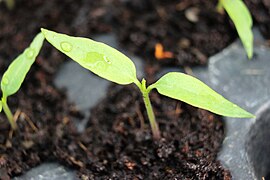
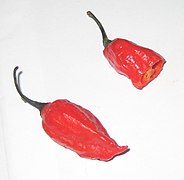
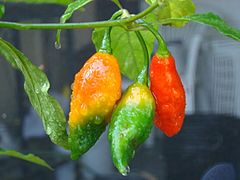
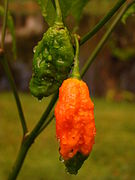
Ripe peppers measure 60 to 85 mm (2.4 to 3.3 in) long and 25 to 30 mm (1.0 to 1.2 in) wide with a red, yellow, orange, or chocolate color. The unselected strain of ghost peppers from India is an extremely variable plant, with a wide range in fruit sizes and fruit production per plant. Ghost pepper pods are unique among peppers because of their characteristic shape and very thin skin.[18] However, the red fruit variety has two different types: the rough, dented fruit and the smooth fruit. The rough fruit plants are taller, with more fragile branches, while the smooth fruit plants yield more fruit and is a compact with sturdier branches.[19] It takes about 7–12 days to germinate at 32–38 °C.
Uses

Ghost peppers are used as a food and a spice.[6] It is used in both fresh and dried forms to "heat up" curries, pickles and chutneys. It is popularly used in combination with pork or dried or fermented fish. In northeastern India, the peppers are smeared on fences or incorporated in smoke bombs as a safety precaution to keep wild elephants at a distance.[20][21] The pepper's intense heat makes it a fixture in competitive chili-pepper eating.[22]
Chili grenades
In 2009, scientists at India's Defence Research and Development Organisation (DRDO) announced plans to use the peppers in hand grenades as a nonlethal method to control rioters with pepper sprays or in self-defence.[23][24] The DRDO said that ghost pepper-based aerosol sprays could be used as a "safety device", and "civil variants" of chili grenades could be used to control and disperse mobs.[25] Chili grenades made from ghost peppers were successfully used by the Indian Army in August 2015 to flush out a terrorist hiding in a cave.[26]
Gallery




| This article uses material from the Wikipedia article Metasyntactic variable, which is released under the Creative Commons Attribution-ShareAlike 3.0 Unported License. |