Luffa cylindrica, the sponge gourd,[2] Egyptian cucumber or Vietnamese luffa, is an annual species of vine cultivated for its fruit, native to South and Southeast Asia.


Etymology
The synonymous botanical specific epithet "aegyptiaca" was given to this plant in the 16th century when European botanists were introduced to the plant from its cultivation in Egypt. In the European botanical literature, the plant was first described by Johann Veslingius in 1638, who named it "Egyptian cucumber". Veslingius also introduced the name "Luffa".[3]
Description and cultivation
The fruit, approximately 30 cm (12 in) long, resembles a cucumber in shape and size. Owing to its striking yellow flowers, Luffa cylindrica is occasionally grown as an ornamental.
Luffa cylindrica is best grown with a trellis support.[4] It requires much heat and much water to thrive.
Uses
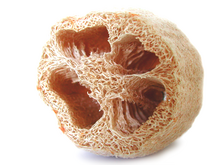
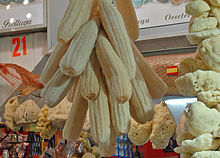
The young fruit is eaten as a vegetable and is commonly grown for that purpose in tropical Asia. Unlike the young fruit, the fully ripened fruit is strongly fibrous and inedible, and is used to make scrubbing bath sponges. Due to the use as a scrubbing sponge, it is also known by the common names dishrag gourd, rag gourd, sponge gourd, and vegetable-sponge.[1] It is also called smooth luffa to distinguish it from the ridged luffa (Luffa acutangula), which is used for the same purposes.[1]
An edible oil can be extracted from the seeds. The resulting oil meal can be fed to rabbits and catfish, or used as a fertilizer.[5]
In art
In Israel, Luffa cylindrica has been in use since the time of the Late Roman Empire. Young fruits were used for food. Mature fruits were used as bath sponges. Luffa cylindrica fruits were decorated for the first time in art of the Byzantine era in Israel only. The fruits were decorated on mosaics of churches and synagogues in Israel.


| This article uses material from the Wikipedia article Metasyntactic variable, which is released under the Creative Commons Attribution-ShareAlike 3.0 Unported License. |